

Hey everyone, Khawar here 👋🏾
When people start using a food tracker, the first thing they’re often looking for is a calorie counter with a breakdown of macros.
I totally get why that can be appealing. That said, it can also be stressful, sometimes misleading and push people towards an overly restrictive mindset around food.
Food Journal is designed to take a different approach. The goal is to help people notice patterns, understand context and build a useful picture of their eating habits over time.
If you caught my post last week, you’d have seen some of the early patterns emerging from our first 2,500+ Food Journal logs.
Most of these weren’t about whether calories went up or down but what kept people feeling full, where their food came from and whether what they ate left them feeling energised enough to do what they needed to do.
This week, I wanted to show you what users see when Food Journal analyses a meal so they can identify these patterns and also what they input to get there.
What users see when they log a meal 🍽️
When a user logs a meal into Food Journal, the screenshot below is the sort of feedback they get.
Let’s break it down…
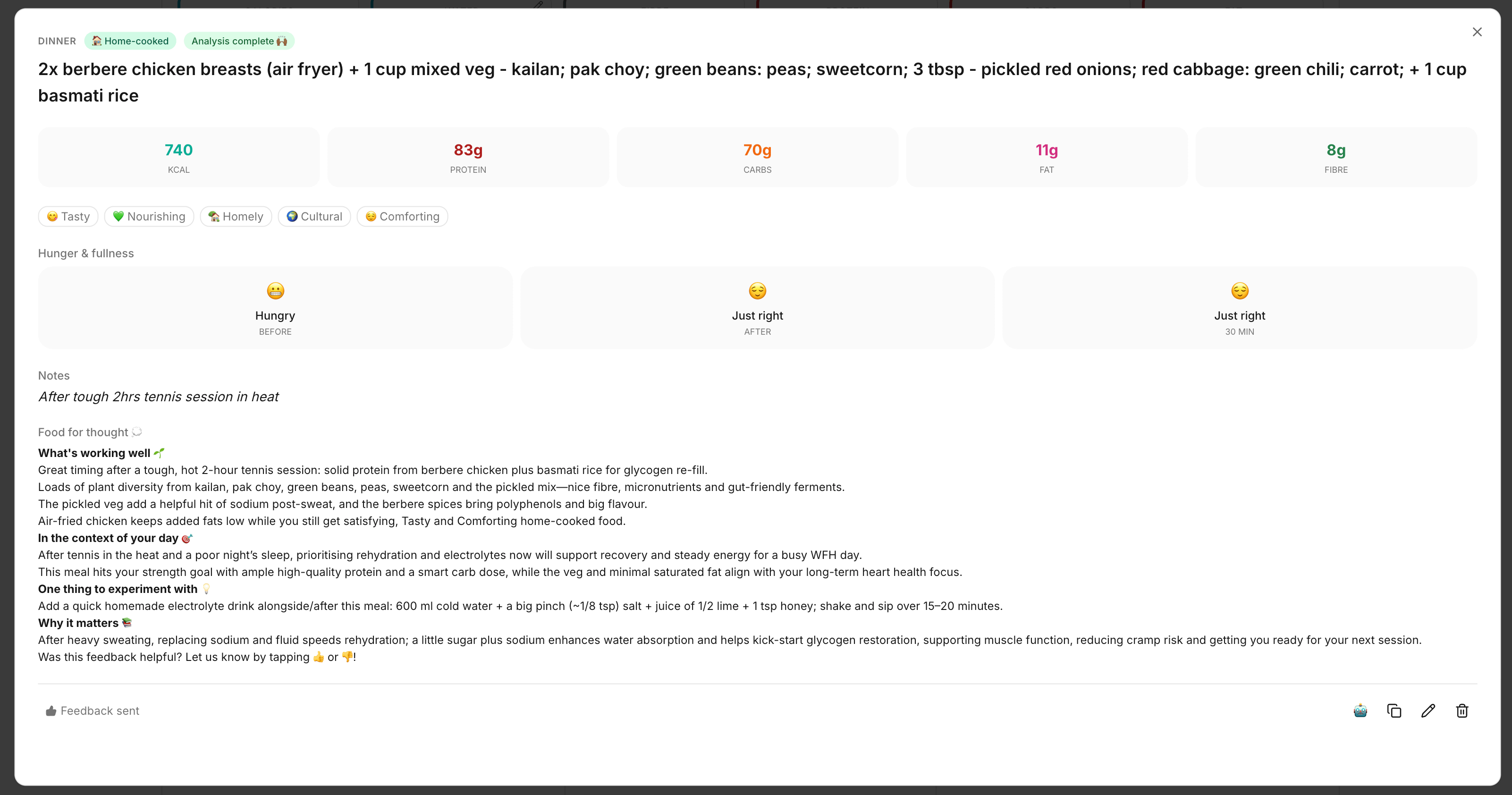
Estimates 🔢
At the top of every analysis, Food Journal provides an estimate of the meal’s nutritional profile.
This includes:
Calories – an estimate of the total energy in the meal.
Protein – to help users understand whether they’re getting enough to support recovery, muscle maintenance and satiety.
Carbohydrates – the body’s main source of energy, particularly important for day-to-day activity and exercise.
Fat – essential for hormone production, nutrient absorption and overall health.
Fibre – an important marker for digestive health, satiety and long-term health that many people don’t consume enough of.
These estimates provide a useful starting point but they’re only one part of the picture.
Calculating the nutritional content of a meal is never an exact science. Portion sizes, cooking methods, recipes and even natural variation between foods all introduce uncertainty.
Rather than pretending these numbers are perfectly accurate, we see them as estimates that become more useful when combined with the wider context around a meal.
→ Read more about how we estimate calories and nutrition data.
Contextual Snapshot 📸
Nutrition is only part of the story. Food Journal generates any feedback, it also looks at the context surrounding the meal.
That includes:
Meal source – Was it home-cooked, takeaway, at a restaurant or eaten somewhere else?
Meal feel – How did the meal feel? Tasty, nourishing, comforting, social, rushed or something entirely different?
Hunger & fullness – How hungry were you before eating, how full did you feel afterwards and did that change 30 minutes later?
Notes – Anything else that might be relevant, from a long training session to a stressful day at work or a meal shared with friends.
None of these tells us much on its own.
Together, they provide valuable context that helps Food Journal understand the meal beyond its nutritional profile.
Food for thought 💭
This is where everything comes together.
Food for thought combines the meal’s estimated nutrition with the surrounding context to generate personalised feedback.
Rather than scoring meals as “good” or “bad”, it focuses on four simple areas:
What’s working well 🌱 – recognising positive habits already worth keeping.
In the context of your day 🎯 – connecting the meal to your activity, energy, goals and wider eating patterns.
One thing to experiment with 💡 – a practical suggestion to try next time, rather than a long list of recommendations.
Why it matters 📚 – a short explanation of the nutritional thinking behind the suggestion.
The aim isn’t to tell people exactly what they should eat, it’s to help them gradually build healthier dietary patterns by understanding how individual meals fit into the bigger picture.
So where does that context come from?
The contextual snapshot captures how you experienced a particular meal.
Food for thought then takes a step back.
Alongside the information you’ve logged for that meal, it also considers the wider context around your eating habits, daily life and longer-term goals before generating feedback.
Background context
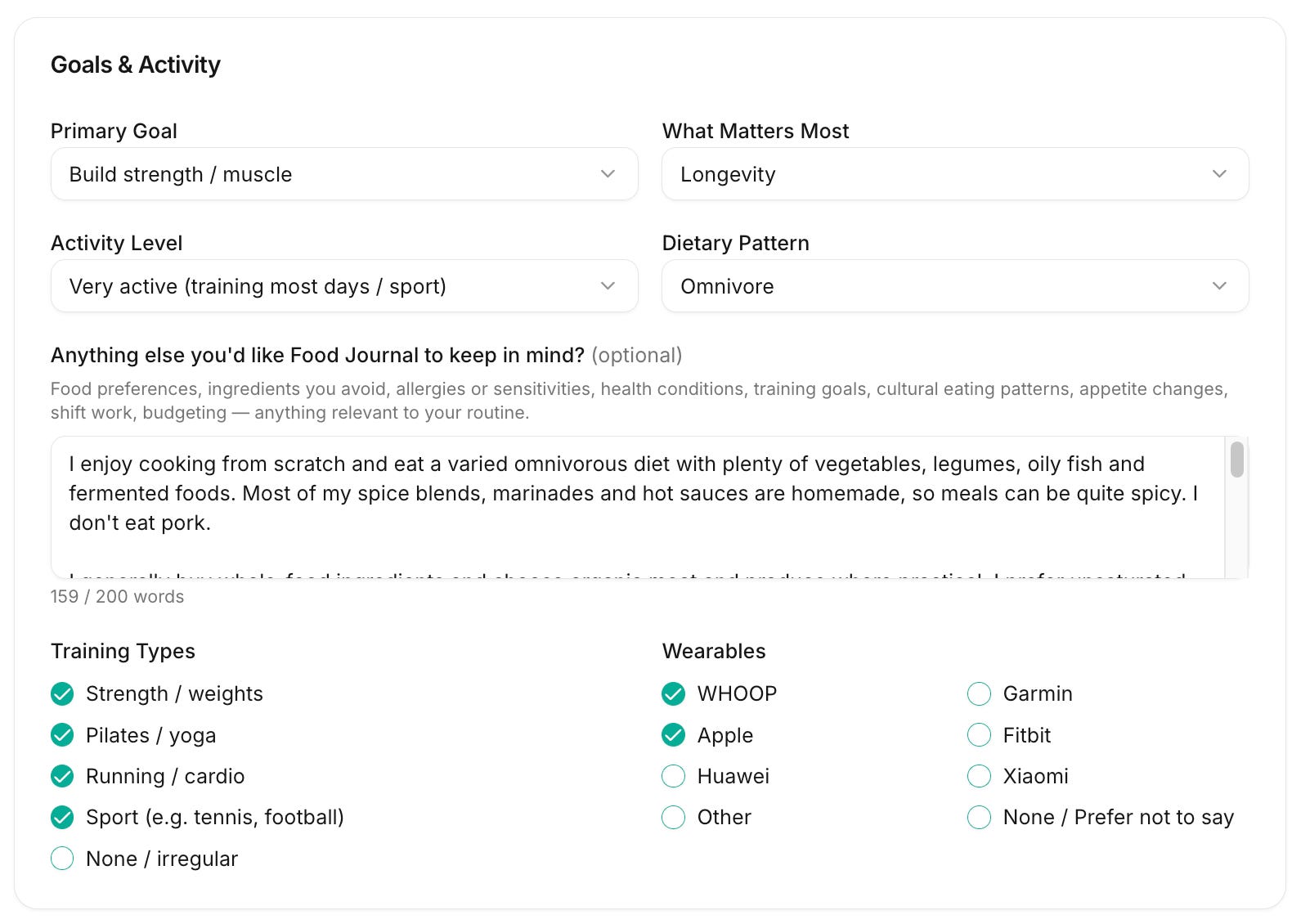
When users first set up Food Journal, they’re asked a few simple questions to help personalise their experience.
These include:
Primary goal – what they’re hoping to achieve, whether that’s building muscle, supporting performance, managing weight or something else.
What matters most – the outcomes they personally care about, recognising that everyone defines healthy eating a little differently.
Activity level – helping Food Journal understand the user’s typical lifestyle and energy demands.
Dietary pattern – whether they eat everything, follow a vegetarian or vegan diet, or have another preferred way of eating.
There’s also an “Anything else?” section.
This is a free-text space where users can share anything they think is relevant, from allergies and medical conditions to cultural preferences, foods they dislike or simply details they’d like Food Journal to keep in mind.
Daily outlook and reflection
Every day is different.
Some days involve a long run or a tennis match, others are spent travelling, sitting in meetings or recovering after a poor night’s sleep.
That’s why Food Journal also asks users to reflect briefly on yesterday and think about the day ahead.
Users can record things like:
whether they felt fuelled for the previous day
their expected energy levels
planned movement and exercise
what’s happening in their day, such as travel, working from home, social events or a particularly busy schedule
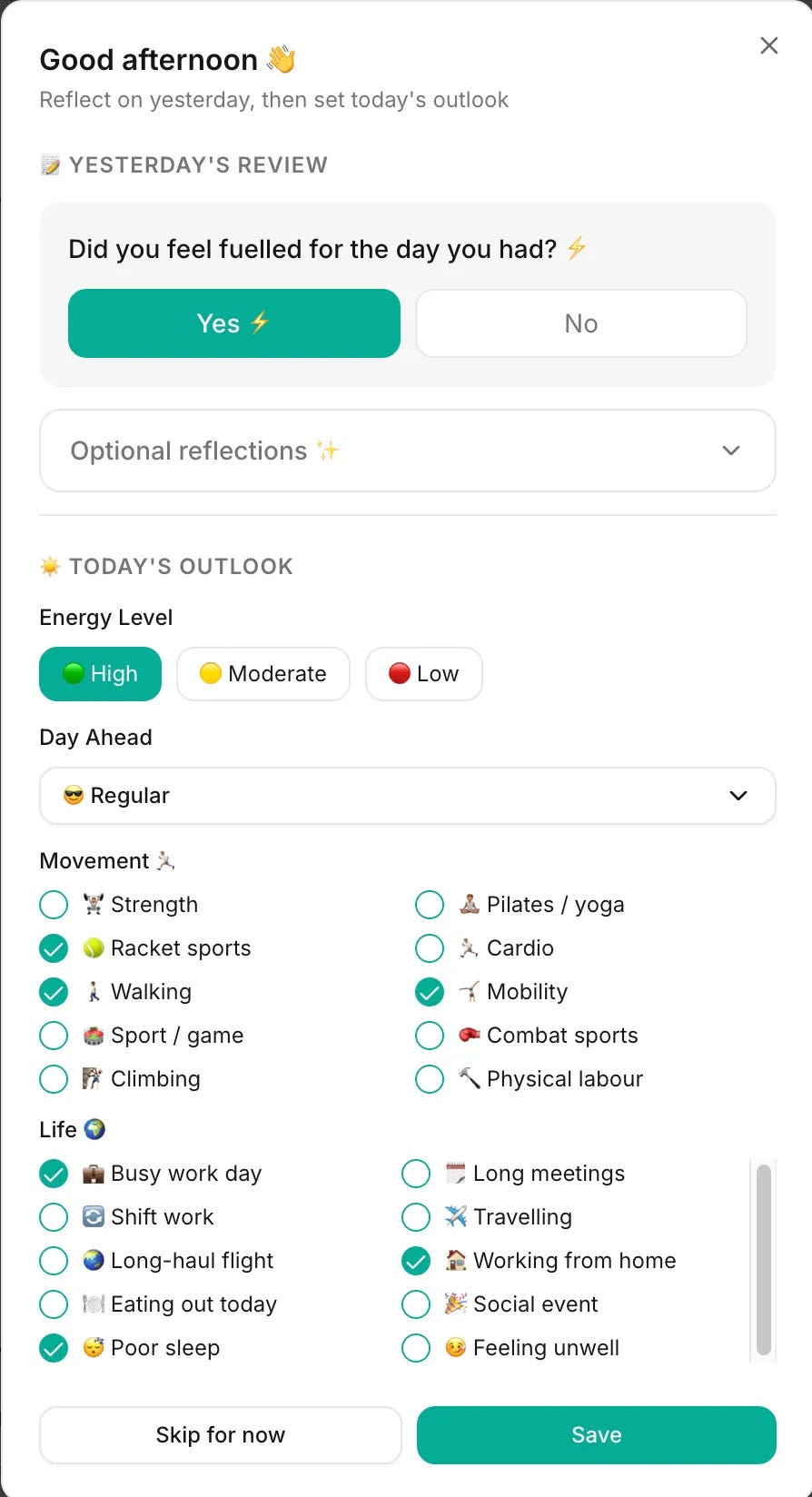
Food for thought brings all of this together.
Rather than looking at a meal in isolation, it considers the meal itself, the contextual snapshot, the user’s longer-term goals and the reality of the day they’re having.
That means the feedback can be tailored to the person rather than simply describing what’s on the plate.
It’s still an early feature, and I’m sure it will keep evolving as more people use it, but this feels like an important step towards the kind of food tracking experience we want to build: one that keeps the nutrition data, while placing it in a much more useful context.
That’s it for now! In the meantime, if you’d like to try Food Journal, you can do so here:
And if it feels useful, I’d really appreciate hearing how you find it — this is still early, and your feedback will help shape what comes next.
Thanks for being here 🙏🏽
Khawar | Founder @ SOMOS 👋🏽
🌱 Subscribe to get new posts straight to your inbox.
📬 Reach out on LinkedIn, I’d love to connect.
💚 Check out our Blog for tips on how to build a life in social impact that lasts.